BYD and Tesla Diagnostics or Battery Repair: What Workshops and Distributors Need to Build a Real EV Aftersales Business
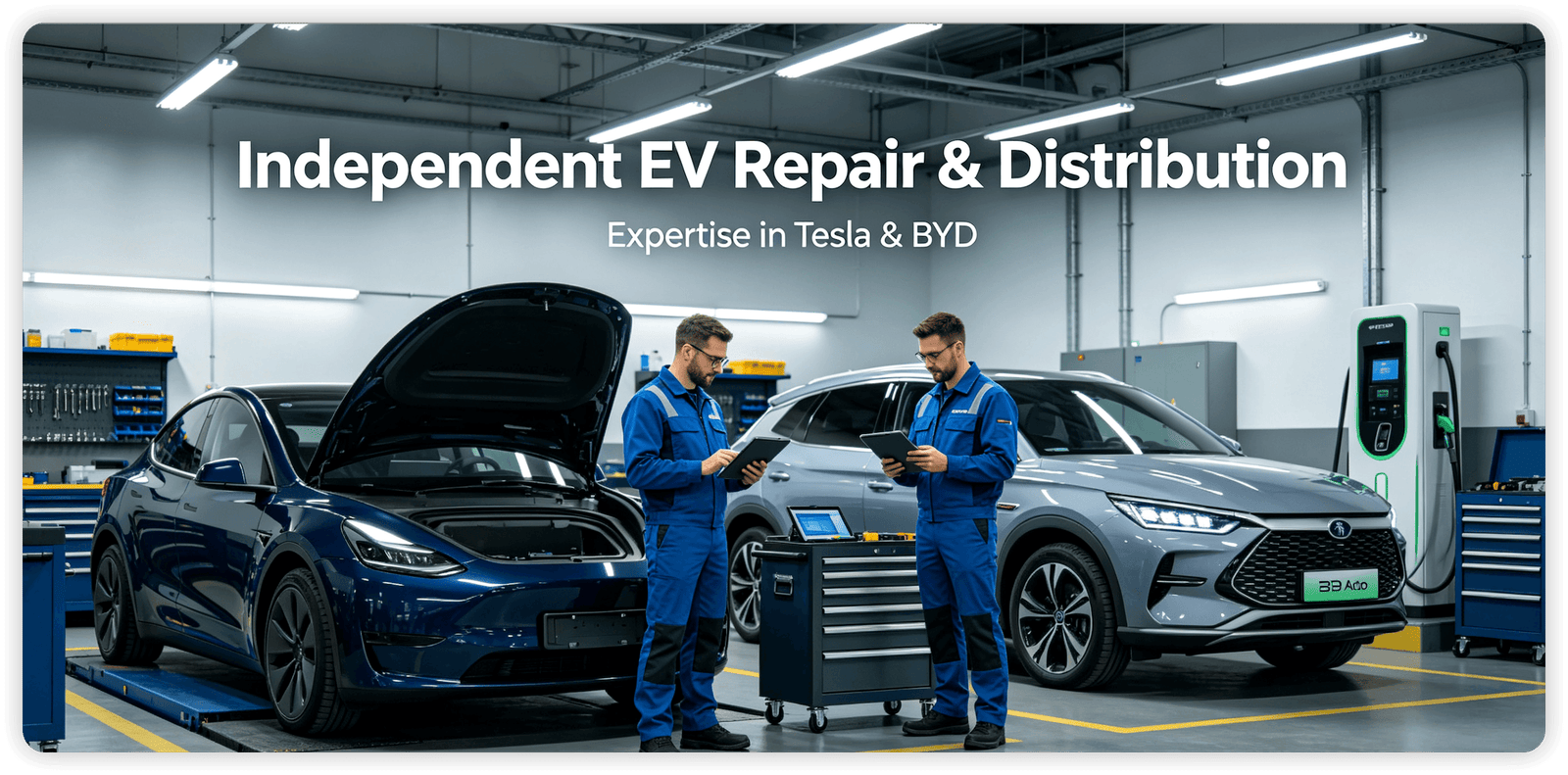
As EV adoption accelerates, the aftermarket for Tesla and BYD is entering a real service window. For many distributors, independent workshops, collision repair centers, and regional service networks, this is no longer only about moving replacement parts. It is about whether they can build a workable EV after-sales model around Tesla diagnostics, BYD diagnostics, and battery-related repair capability.
In practical terms, the question is not simply whether one part can be sourced. The real question is whether a business can combine Tesla diagnostics, battery fault assessment, technician training, and parts supply into one operating system that helps customers solve actual repair problems. Tesla itself openly provides Service Mode as a diagnostic and repair interface for internal and third-party technicians, which makes one thing very clear: Tesla diagnostics is no longer a niche topic. It is part of the real aftermarket workflow.
That is why the most valuable players in the next phase of the EV aftermarket will not be the ones who only quote parts faster. They will be the ones who can connect Tesla diagnostics, Tesla battery repair judgment, BYD battery repair support, fitment analysis, technical guidance, and repeatable parts supply. This shift matters especially for workshop owners and distributors who want to move beyond one-off orders and build recurring revenue from EV service.
If a workshop can run Tesla diagnostics but cannot find the correct parts, it loses time. If a distributor can sell parts but cannot support Tesla diagnostics or battery-related workflow, it loses trust. The market is moving toward integrated execution, not isolated transactions.
Why Tesla and BYD Aftersales Demand Is Moving Toward Independent Repair and Distribution
Tesla is no longer just a new-energy vehicle sales story. In many markets, Tesla has already become an aftermarket story. Vehicle populations have accumulated, older units are moving deeper into the repair cycle, and independent workshops increasingly need Tesla diagnostics to evaluate charging faults, 12V system issues, thermal management problems, sensor faults, collision-related concerns, and battery-related warnings. Tesla’s public documentation states that Service Mode is designed to help internal and third-party technicians service Tesla vehicles more efficiently. That is direct confirmation that third-party Tesla diagnostics now belong in the real service landscape.
For distributors, this means the sales opportunity is shifting from simply stocking body parts to supporting workshop execution.
BYD is approaching the market from another direction. In many overseas markets, BYD is growing quickly, but local after-sales capability does not always mature at the same speed. That creates a gap. Workshops may see more BYD vehicles coming in, but they may still lack BYD diagnostics, battery risk assessment experience, technician training, or a stable parts path.
Reporting about BYD launching a battery repair centre in the UK shows that battery repair is becoming an organized service topic, not just a theoretical discussion. Specialist repair content around collision checks and battery or structural assessment points the same way: BYD battery repair and battery inspection are entering practical workshop conversations.
This is why the real profit pool in EV aftersales does not sit in one isolated SKU. It sits in the workflow around diagnosis, safe handling, parts selection, repair, calibration, and repeat support. A distributor that understands Tesla diagnostics for workshops, battery-related risk, and part matching has more value than a distributor that only sends a catalog. A workshop that can combine Tesla diagnostics, BYD diagnostics, and battery repair judgment with the right supply chain is much harder to replace.
Why Parts Alone Do Not Solve EV Repair Problems
A large share of EV repair requests looks like a parts request on the surface, but turns out to be a Tesla diagnostics or BYD diagnostics problem first. A charging issue does not always mean the charging port is bad. A battery warning does not automatically mean the whole pack must be replaced. A post-collision vehicle may need a battery-zone inspection before anyone can safely judge the next step.
A workshop that skips diagnosis and jumps directly to ordering risks misjudgment, delay, extra cost, and customer frustration. That is why Tesla diagnostics is not an optional extra. It is often the first gate in the repair chain.
This is especially true when workshops move from ICE habits into EV service. EV battery checking cannot simply rely on the old multimeter-and-routine-replacement mindset. The implication is bigger than one battery. It means workshops need a higher baseline of BYD diagnostics, process control, and system-level understanding. The same logic applies to Tesla diagnostics. Once the vehicle architecture changes, the business model around repair has to change too.
For distributors, the message is equally important. A catalog may help the customer find part numbers, but it does not tell them whether the fault root cause is electrical, thermal, software-related, structural, or battery-related. That is why a strong EV aftermarket partner needs to support both matching and workflow. Resources such as the Tesla Parts Catalog, Tesla Part Number Search, and Tesla Body Parts can help buyers narrow down fitment and sourcing paths, but the buying journey still begins with proper Tesla diagnostics in the workshop.
 Tesla Diagnostics and BYD Diagnostics Are Not Just Tools. They Are Operating Capabilities.
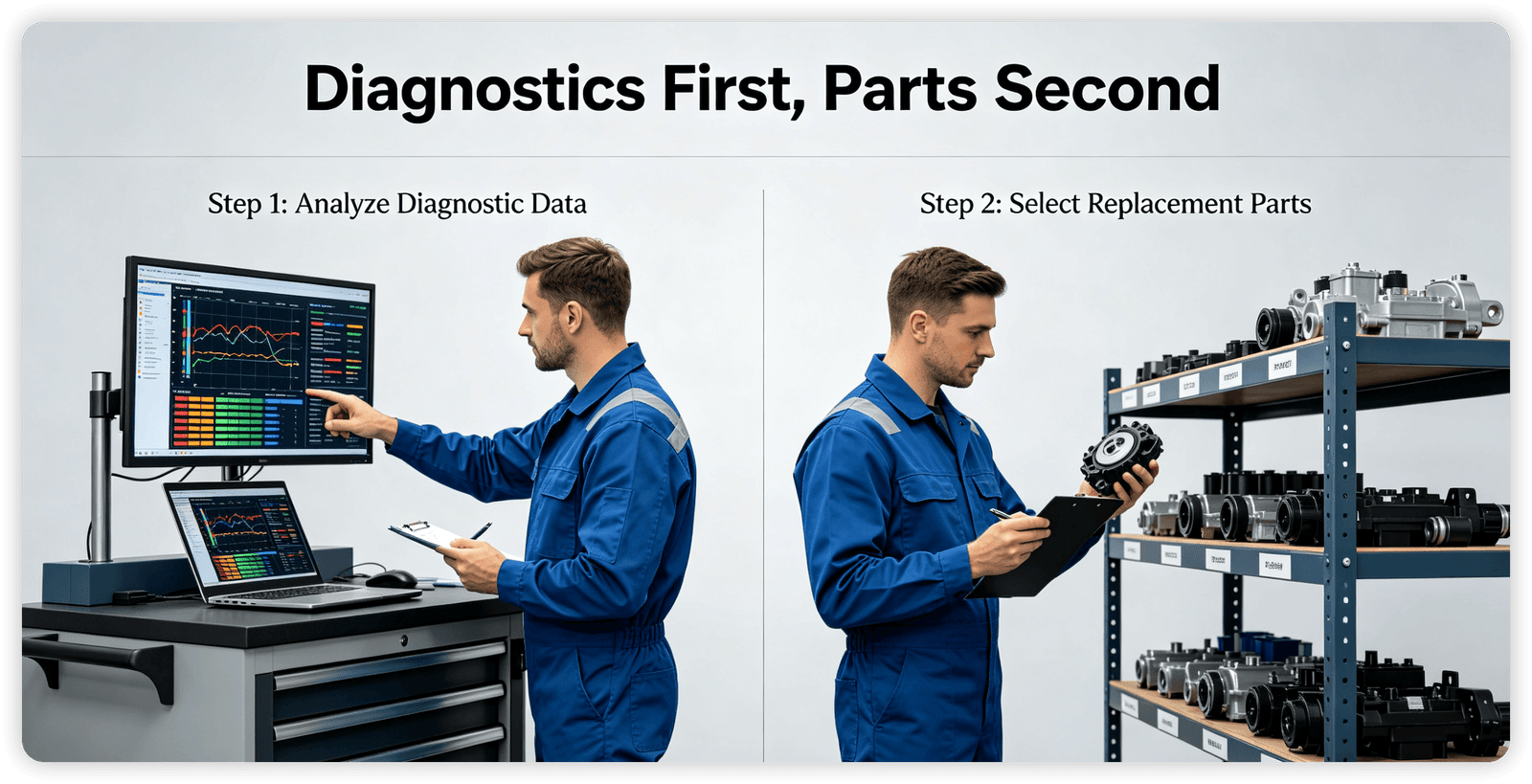
When people search for Tesla diagnostics, they often think they are searching for a scanner, a software menu, or an access method. In reality, Tesla diagnostics is a broader operating capability. It includes fault-code reading, live data interpretation, charging system analysis, battery condition review, service workflow judgment, and the ability to connect that information to the right repair action.
Tesla’s official documentation says Service Mode is a diagnostic and repair interface, and related service instructions also show that high-voltage battery work requires the right certification level. In other words, Tesla diagnostics is tied to process discipline, not just access.
The same is true for BYD diagnostics and BYD battery repair. A workshop entering BYD service needs to understand what can be checked at the first stage, what requires battery-zone caution, what should be escalated, and what parts path makes commercial sense. BYD battery repair is moving toward structured service capability, and workshops need more than a one-time answer. They need a repeatable support model.
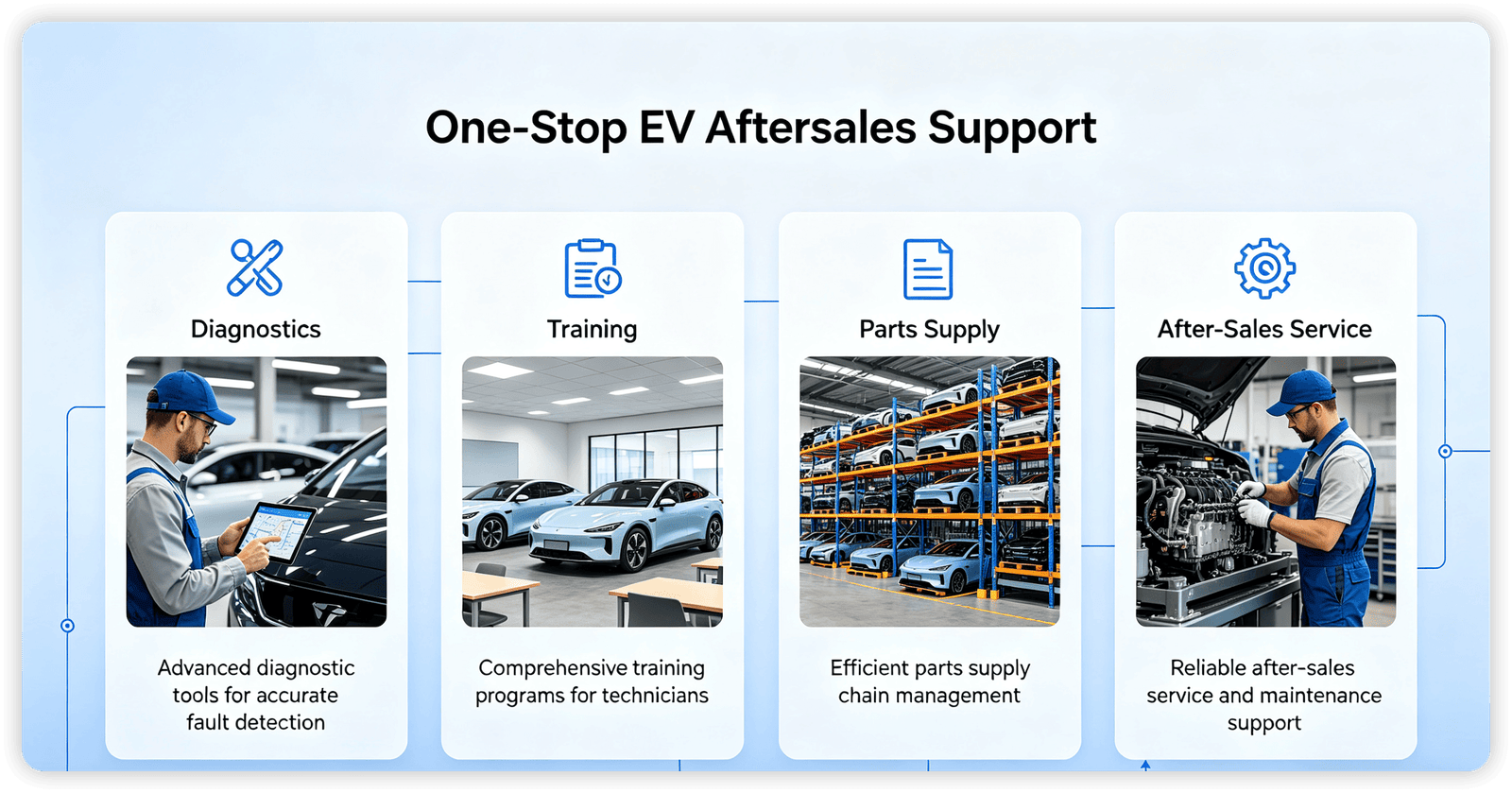
That is why EV after-sales capability usually has four layers. First is basic diagnosis: Tesla diagnostics, BYD diagnostics, fault reading, and condition checks. Second is the high-voltage safety and repair workflow. Third is parts and fitment control. Fourth is ongoing training and remote support. If one layer is weak, the whole system becomes fragile.
A workshop may know Tesla diagnostics but still fail on parts matching. A distributor may know SKUs but still fail to support battery-related service. The best aftermarket players build all four layers together.
The Smart Entry Path Is Not to Start with Full Battery Pack Repair
Many workshops hesitate because they think EV service means going straight into full battery pack repair. That is the wrong starting assumption. A more practical path is to begin with high-frequency service scenarios where Tesla diagnostics creates immediate value: charging checks, 12V system diagnosis, connectors and harness-related faults, sensor-related issues, thermal management troubleshooting, and collision-related battery-area checks.
These jobs create service demand now, and they also create parts demand that distributors can support more efficiently.
The second stage is capability building. That means technician training, high-voltage safety rules, case-based learning, removal-and-installation discipline, and a better understanding of what Tesla diagnostics can confirm and what still requires deeper escalation. Only after that does it make sense to move into more complex battery-related repair workflows.
This phased path matters commercially because it reduces risk, shortens the learning curve, and lets workshops monetize Tesla diagnostics for workshops earlier instead of waiting for a perfect future setup.
For distributors, this phased model also helps with planning. Instead of trying to be everything at once, they can support workshops with the categories most closely tied to diagnosis and repair frequency. That is one reason pages such as Tesla Wholesale Parts and How to Find Tesla Spare Parts Availability matter. The job is not just to show inventory. It is to help partners connect Tesla diagnostics, repair workflow, and the right stocking logic.
Why Many Workshops See the EV Opportunity but Still Fail to Capture It
The real bottleneck is not demand. It is execution capability. Many workshops buy tools but do not invest enough in training. Others can replace parts, but cannot correctly identify the root cause through Tesla diagnostics or BYD diagnostics. Some can quote repairs but cannot secure a reliable parts channel. Others understand parts but not version differences, VIN matching, or workflow timing. In all of these cases, the market opportunity exists, but the operating chain is incomplete.
This is especially damaging in EV repair because trust is easily lost. If a workshop promises a result and then discovers it misreads the problem, the customer’s cost is higher than in many ordinary ICE repair cases. If a distributor pushes a part without helping the customer think through the repair logic, returns and complaints become more likely. That is why Tesla diagnostics, Tesla battery repair training, and fitment support should be treated as connected business functions, not separate conversations.
Where to Find Tesla / BYD Diagnostics or Battery Repair Support
Official systems remain important. Their strength is structure, documentation, and clearer technical standards. Tesla’s public Service Mode and related service materials give workshops a serious technical foundation and confirm that Tesla diagnostics has a formal place in third-party service work. But official documentation alone does not automatically create a local operating model for independent workshops or distributors. High-voltage battery procedures also carry significant training expectations, which raises the threshold for real-world execution.
Diagnostic tool providers are another route. They can help workshops perform Tesla diagnostics and BYD diagnostics more effectively, and that has clear value. But most tool-focused solutions mainly solve the diagnostic layer. They do not always solve parts sourcing, fitment planning, fast-moving category decisions, or workshop enablement. Local training institutions can improve technician basics, but they may not stay connected to real parts supply and real repair cases.
That is why many distributors and workshops eventually need something broader than a tool, a class, or a document set. They need a one-stop EV aftermarket partner that can connect Tesla diagnostics, BYD diagnostics, technician learning, fitment support, and parts supply in one workflow.
Why a One-Stop EV Parts and Service Support Model Makes More Sense
For distributors and workshops, the goal is not simply to buy parts. The goal is to build a workable EV after-sales business. That is why a one-stop model makes commercial sense. A practical partner should be able to support Tesla diagnostics, repair-related part selection, fitment judgment, workshop-facing technical communication, and training resources. Resources such as Tesla Parts Catalog, Tesla Part Number Search, Tesla Body Parts, and Tesla Wholesale Parts help buyers narrow down categories and fitment logic, but the bigger value is not one page or one SKU. It is the ability to connect Tesla diagnostics and a repeatable supply support.
Kylin EV Parts is positioned as a B2B EV parts supplier focused on Tesla, BYD, VW ID, and other new energy vehicles, with buying-guide content built around wholesale parts, part number search, body parts, and catalog-based sourcing. That makes it relevant not only for parts demand, but also for distributors and repair-oriented buyers who want a more complete EV aftermarket structure. In practice, that can include fast-moving category support, model-based sourcing, training-related coordination, and support around Tesla diagnostics or battery-related workflows.
The future of the EV aftermarket will not belong to the company that only ships parts. It will belong to the company that can help distributors and workshops build execution capability. Tesla diagnostics is central to that shift because it sits at the beginning of the service chain. Tesla diagnostics helps define the fault path, the repair logic, the part path, and often the trust level of the customer relationship. The same is increasingly true for BYD diagnostics and BYD battery repair.
As EV volumes continue to rise, workshops and distributors that can connect Tesla diagnostics, battery repair judgment, training, and parts supply will be in a much stronger commercial position.
If you need a practical foundation for parts sourcing and technical support, please contact Kylin EV Parts. With the right combination of parts supply, repair-related support, training resources, and ongoing service assistance, Tesla diagnostics can become more than just a concept. It can become a workable business capability for workshops and distributors.